
Multifamily's Refinancing Wall Is Forcing Sellers to the Table
Apartment owners have spent three years waiting for rates to fall, and they are running out of time. A Wall Street Journal review of the apartment debt market, summarized by CRE Daily, found more than $1.8 trillion of multifamily debt coming due over the next decade. Roughly $757 billion of it matures between 2026 and 2028, the largest near-term total of any major commercial real estate sector. The question is no longer whether that debt gets repriced. It is who can afford the new price.
The Maturity Schedule Is Front-Loaded
Nearly $300 billion in apartment loans comes due in 2026, following a record $310 billion in 2025. Much of it was originated in 2020 and 2021, when multifamily was the favored sector, rents were rising at double-digit rates, and mortgage rates sat near 3%. Those loans were underwritten on assumptions that did not survive the next two years. Phoenix, Denver, Atlanta and Austin absorbed waves of new luxury supply just as borrowing costs climbed.
The Math Has Roughly Doubled
Owners refinancing today face rates near 6%. For many, that means covering the gap with fresh equity, selling, or negotiating with the lender. TruAmerica Multifamily's CEO described one Raleigh property with a 3.5% loan coming due. Keeping it would mean refinancing near 6% and writing a large check, so the firm is weighing a sale instead. Rates are not helping. The Federal Reserve raised its benchmark rate 25 basis points on September 16 to a range of 3.75% to 4%, its first hike since 2023, and the 10-year Treasury pushed back above 5% the same week.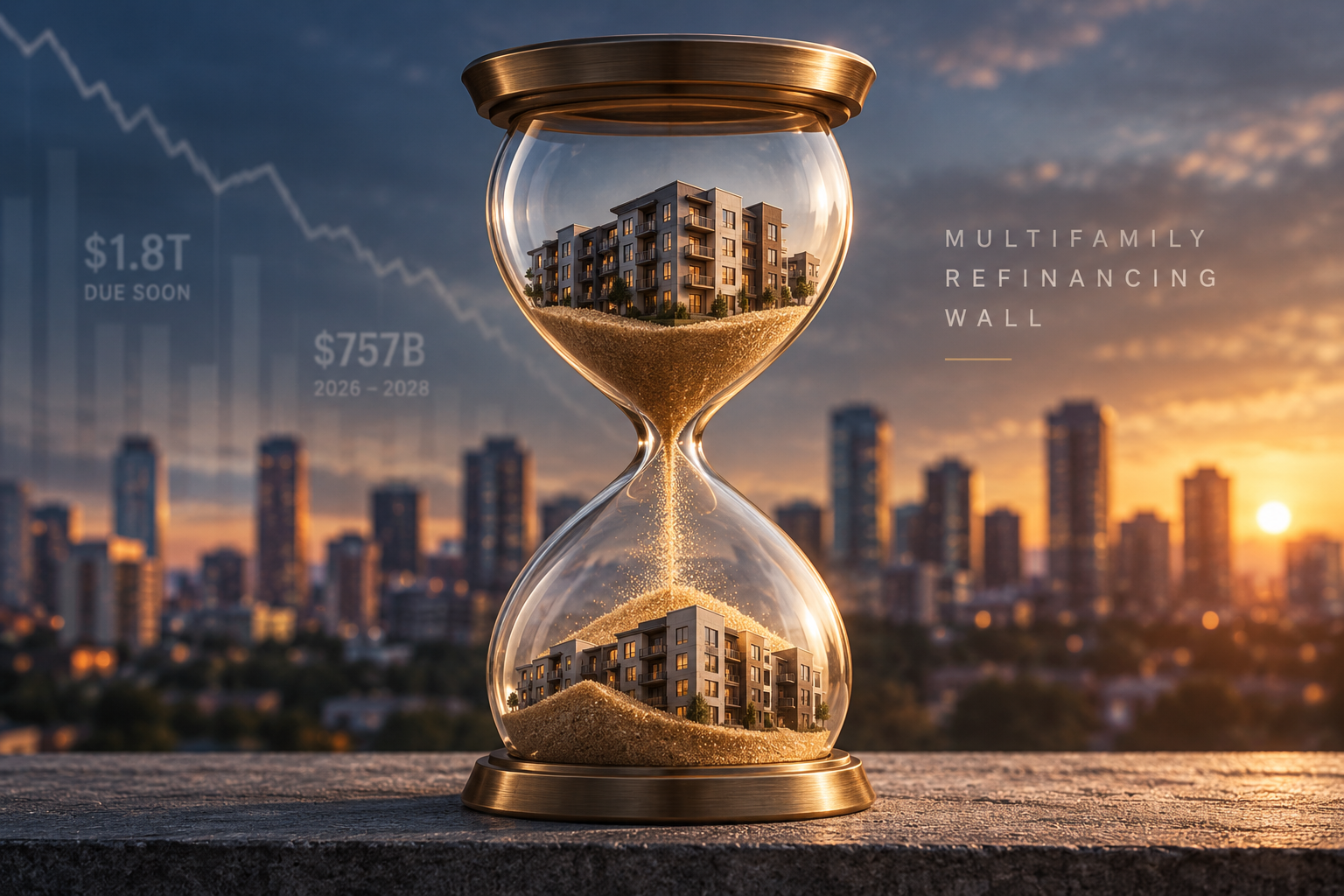
Lenders Have Stopped Waiting
For several years, lenders and borrowers extended troubled loans and waited for rents and rates to cooperate. That patience is ending. Bain Capital's real estate head said creditors are becoming more aggressive, and the pressure is no longer limited to small syndicators. Blackstone defaulted in June on a $90 million loan tied to a North Dallas apartment property bought in 2021. S2 Capital has accumulated $400 million in defaults across its Sun Belt portfolio and plans to sell six properties for $290 million.
Distress Is Showing Up in the Numbers
Morgan Stanley puts multifamily CMBS delinquencies at 7.1% this year, up from 1% in October 2023, the largest increase of any major property type. Trepp reports about 3% of non-extendable loans maturing this year are in distress, the highest share in five years. Across all CMBS, Colliers found that maturity defaults drove 81% of new delinquencies in August. Green Street estimates apartment values remain more than 20% below their 2022 peak.
Buyers With Cash Are Moving In
The other side of forced selling is discounted buying. Cityview is purchasing a renovated Dallas-area complex directly from a lender at roughly a 40% discount following foreclosure, something the firm had not done in years. In many of these cases the buildings are not broken. The capital structures are. Operating fundamentals are also improving at the margin, with CoStar now expecting national rents to rise 1.9% by year-end, up from a prior forecast of 0.5%.
The Bigger Picture
The refinancing wall is less a property problem than a leverage problem. Buildings bought at 2021 prices with 2021 debt are being repriced against 2026 rates, and owners who cannot bridge that gap are being pushed to sell. That is painful for those borrowers, but it is also how price discovery finally happens in a market that has spent three years avoiding it. With roughly $757 billion maturing through 2028 and lenders less willing to extend, the number of motivated sellers is likely to grow before it shrinks.
For Neighborhood Ventures, this is the part of the cycle a disciplined buyer waits for. Stress concentrated in over-levered 2021 acquisitions means more well-located Phoenix assets trading on the seller's timeline instead of the market's, often at a basis well below what it would cost to build today. That's the kind of setup we want to be transacting in.
About the author
Neighborhood Ventures